Victoria Street Collective
Ruth Giles, resident and project initiator
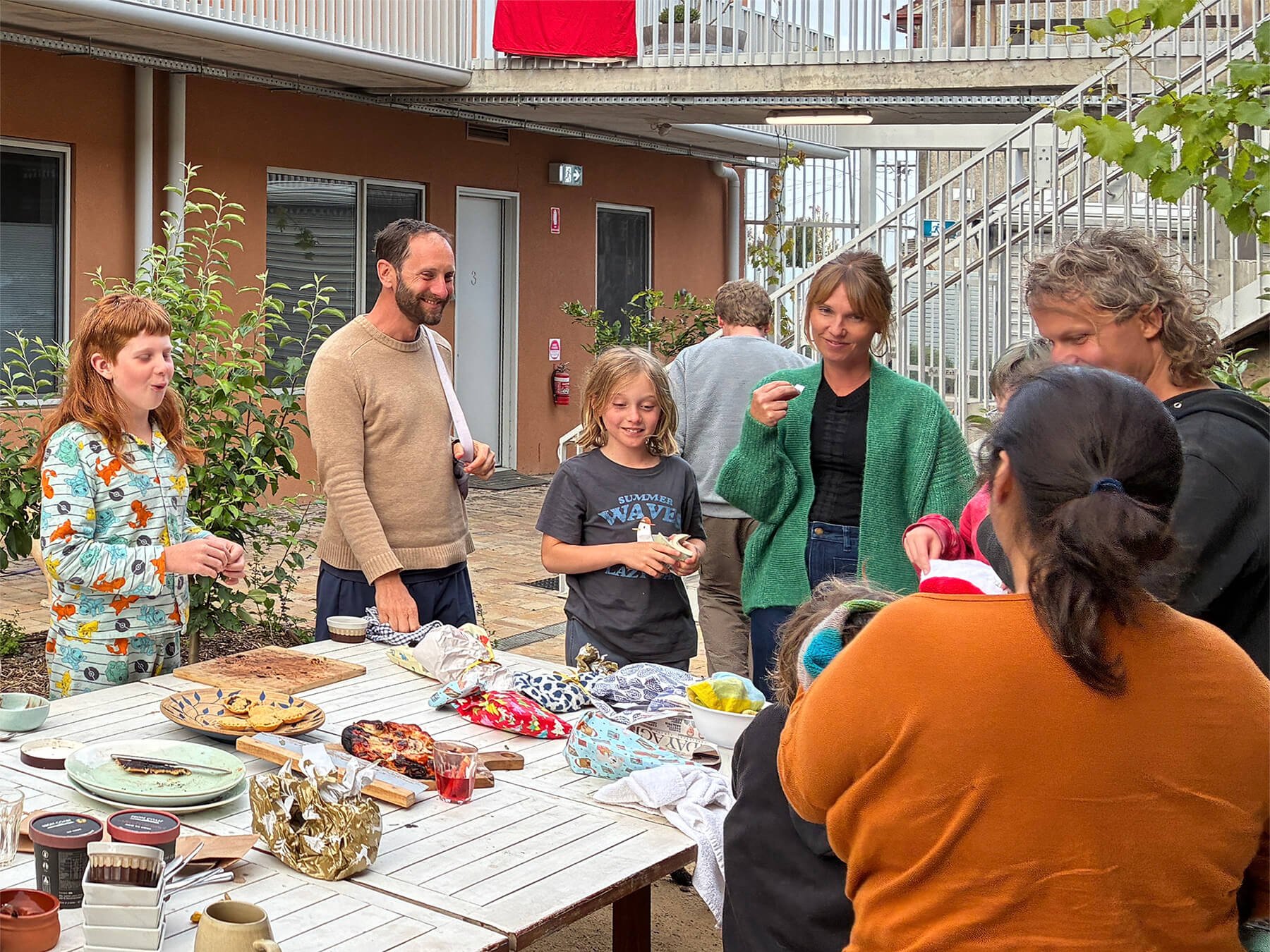
Gathering in the courtyard at Victoria Street Collective. Source: Ruth Giles
Ruth Giles is a resident of Victoria Street Collective, the ninth group build project by Property Collectives. As a project initiator, Ruth shares her experience of the entire process; from acquiring the site and finding other people to join the resident-led initiative, through financing and capital contributions, to design and construction.
Central to living in an intentional community, Ruth discusses how the resident group approaches collective decision making. As an advocate for alternative housing models, Ruth outlines the challenges that resident-led developments should consider, along with the enormous benefits of living in a multi-generational community.
Reading time: 13 minutes
You’ve been living at Victoria Street for over a year now. We’ll explore this further, but how have you found the experience of living in an intentional community?
It's fabulous! I think there's a really good balance. People can just get on with their daily lives, and you can choose how much you engage depending on how busy you are and whether you’re looking for company. There are so many incidental conversations with our neighbours and different ways in which we help each other out. People of all ages live here, and the courtyard has really come to life as a place to gather.
Where you are today started back in 2014. What was your housing situation at the time and what put things in motion?
We were living in a townhouse at the Hoffman Brickworks in Brunswick. There was a great sense of community, and we enjoyed knowing the neighbours. Then Mum said she wanted to move down from Canberra so we could all be closer. That challenged us to think about what our future housing might look like.
I was pretty sure that a house with a granny flat was a poor idea for us. With Rob (my husband) and I working, and the kids becoming teenagers and being more independent, I didn't want Mum isolated up the back of a garden. I was interested in alternative housing models but didn't necessarily see an option for us.
Then you heard about the stage two development of Westwyck Ecovillage in Brunswick West.
Yes, I'd previously met someone living at Westwyck. There was a lovely vibe among the people already living there and someone suggested it would be a good option for Mum. When she had a look there was only one place available. It was very large and Mum suggested we live together. We decided to sign up, but unfortunately the project didn't go ahead.
That sent us on a journey of looking at what else was out there. We investigated all sorts of things but realised we'd become very anchored in this area with kids in the local kinder and school. There was a lot of change taking place in Brunswick and it felt like things were happening that aligned with what we wanted. We decided to wait and hoped to find something community-oriented around here.
Westwyck then comes back into the story, which led to the purchase of your site.
With stage two of Westwyck not proceeding, they decided to sell the land and contacted me in 2018 to see if we were interested. A friend had introduced me to Tim Riley from Property Collectives, who became the development manager for the project. I asked Tim to run some numbers and the viability stacked up, however there were changes happening to GST and it was unclear how that would impact us.
It literally came down to a decision on 30 June, just ahead of the changes to GST, as to whether we would buy the land. I called Mum and she said, “We'll never know if we don't do it, will we?”. We scrambled together the deposit and signed a contract that day. At that stage it was just Rob and me as one party, with Mum as the second party. The land cost $1.5 million. Property Collectives had introduced us to other parties that were interested in a group build, and fortunately, other people started to join up.
So Westwyck became our neighbours. In 2019 we were then able to buy the corner property to our east which improved the viability of the project by increasing our site area and providing laneway access.
Could you provide an overview of the Property Collectives model?
Property Collectives acted as development manager and advisor, facilitating the end-to-end process. They provided the platform and systems for our resident group to form a joint venture as owner-developers, enabling the residents to collectively design and co-develop their homes. They run an open book process where everything is visible and transparent. Our group paid a percentage on the development cost to Property Collectives as a fee for their services.
“Every morning, I wake up and think about how this place is much better quality than anything I ever expected to live in.”
It’s a great model, but it's important to understand that the resident group who form the joint venture bear the risk. As a buyer in a standard development, you know you've got a fixed price, whereas we took on all the risk including rising costs and ensuring the project didn’t stall.
The joint venture began as two parties: yourself and Rob, and your Mum, with more parties joining at later stages. How are project costs distributed?
You don't incur more costs by joining early. Contributions are adjusted across the project with a final reconciliation at the end. Tim makes capital calls to cover project costs and keep things moving.
For the first part of the process the parties had equal shares. Each incoming party put in capital to catch up with the existing parties, thereby equalising costs. Once we had more clarity on the floor area for each dwelling, the contribution for each party was adjusted to reflect their dwelling size. For some parties, their contribution went up to reflect a larger dwelling, while for those with smaller dwellings it was reduced.
Contributions were adjusted further once the dwellings were valued by the bank, as floor area isn’t a perfect reflection of market value. Some parties also put in additional funding along the way to help us get over some financial hurdles. We sorted out any remaining adjustments with a final reconciliation, ensuring we all paid our share.
What was the process of undertaking a financial assessment for people who wanted to join?
Tim works with a finance broker, Rohan Wood from O2 Finance, who is responsible for helping obtain a take-out loan and doing a financial assessment of the people coming in. You don't see each other's details, with Property Collectives and O2 Finance ‘approving’ you and getting the right number of parties together who collectively can secure the commercial loan.
How receptive were the banks to financing this model of housing?
They're not very receptive. Fortunately, Tim has been cultivating relationships with banks for a long time. Bank Australia provided financing for this project through their impact lending, which is targeted at affordable, accessible and green homes. We were happy with their requirement for an 8-star Nationwide House Energy Rating Scheme (NatHERS) rating. Without Property Collectives, I think it would have been very difficult to secure financing.
Were there challenges in finding people who wanted to join the project and be part of an intentional community?
You need to find people who want to work together and have the people skills to get through the challenges. And they need to have the capital to do so and be willing to take a risk. Finding people for whom everything lines up, including the timing and location, is quite difficult.
We spent a couple of years recruiting and found it hard to get people to commit. You can have criteria about who you'd like to join, but you don't want the project to stall or not proceed, so you also need to be open and see who comes along. We also didn't have access to a big mailing list like Nightingale Housing has. People who showed interest would initially speak with Tim. If they were serious about joining, they'd meet each party one-on-one to ensure everyone was happy.
“I feel very lucky to live in a place like this, where our neighbours share our values and are committed to building community.”
Once we had the site, and then the initial design, it became somewhat easier as we had something more tangible to show people. There's much more uncertainty asking people to commit money early to a process that's unfamiliar with an unknown result.
In the end, there was a lot of word of mouth with many of the residents having existing connections. Some had lived in a big share house together, so they had built trust with each other. They had experience in managing conflicts, setting up systems and living collectively.
You had acquired the site and more people were joining the project. You then started the process of appointing an architect.
Tim sent a survey early on to understand everyone's budget, their minimum requirements, number of bedrooms, and so on. We also had a couple of dinners and workshops to talk about what we wanted.
We used all this information along with previous briefs that Tim provided to write our own design brief which we sent to several architects. Following the initial responses, we hired a room at Siteworks in Brunswick (now Balam Balam Place) and ran interviews with four architects.
The project was on a fine margin, and we were really worried about the risk of planning delays. We interviewed Zen Architects and Ric Zen spoke about how smoothly their previous projects had gone through planning. This was a key factor in the decision to go with them.
How did Zen Architects work with the collective through the design phase?
Everyone had a one-on-one meeting with Zen Architects at the beginning. We then typically met online as a group due to Covid-19 restrictions which wasn't ideal.
It's a different type of relationship with an architect compared to more conventional housing projects. We weren't doing a single-family home where you expect to work closely with your architect, but we also weren't doing a standard multi-unit development where you are not involved in the design or maybe you just choose a colour scheme.
On the one hand we recognised the need to have repetition for economies of scale, but each party in the collective also had their own interests and opinions. That's difficult for any architect to balance. We probably should have been clearer in the brief and interviews about the expected level of resident participation in decisions. And that also applies to the builder during the construction stage.
How did the project proceed through planning?
We were careful about how many things we were pushing in terms of the planning application. We didn't want to get tripped up by pushing in too many areas as we needed to avoid any delays. It progressed pretty smoothly and we received unanimous support from Merri-bek City Council.
You then went through the tendering process to appoint a builder.
Property Collectives undertook due diligence on four companies that had expressed interest in the project, but only two were willing to tender for it. Property Collectives ran an open book assessment, so we could all see how it looked, including the agreed builder's margin of 10 per cent.
Due mostly to Covid-19, both tenders came back higher than expected. By this stage all parties had signed up. While most people had an existing home or an inheritance to draw on, some were at risk of not being able to secure a mortgage. As there were existing friendship groups within the collective, we were very committed to keeping everyone in. We appointed Maven Builders and started looking at what we could value manage to try and reduce the financial stress.
Construction started in 2022 after the Covid-19 lockdowns, but the pandemic had impacts on the build.
Supply chain costs went up massively. We ended up having to bring some payments forward so that sub-contractors had a sufficient financial pipeline to buy materials.
Property Collectives made arrangements with the builder and sub-contractors that if there were any cost pressures, they needed to be informed, and then Tim would talk to us. Managing the cost pressures together is part of the reason that we made it through.
In the end, I think the cost escalation was around 20 per cent. This was a very large escalation, especially for the people who were financially limited in the first place. It's an example of the risks that building groups take on and the need to understand the complexity of what you're doing. Things really need to be locked in to be sure about the cost. As owner-developers we were determined to continue. There are varying opinions in the group about how well the costs and risks were communicated to us.
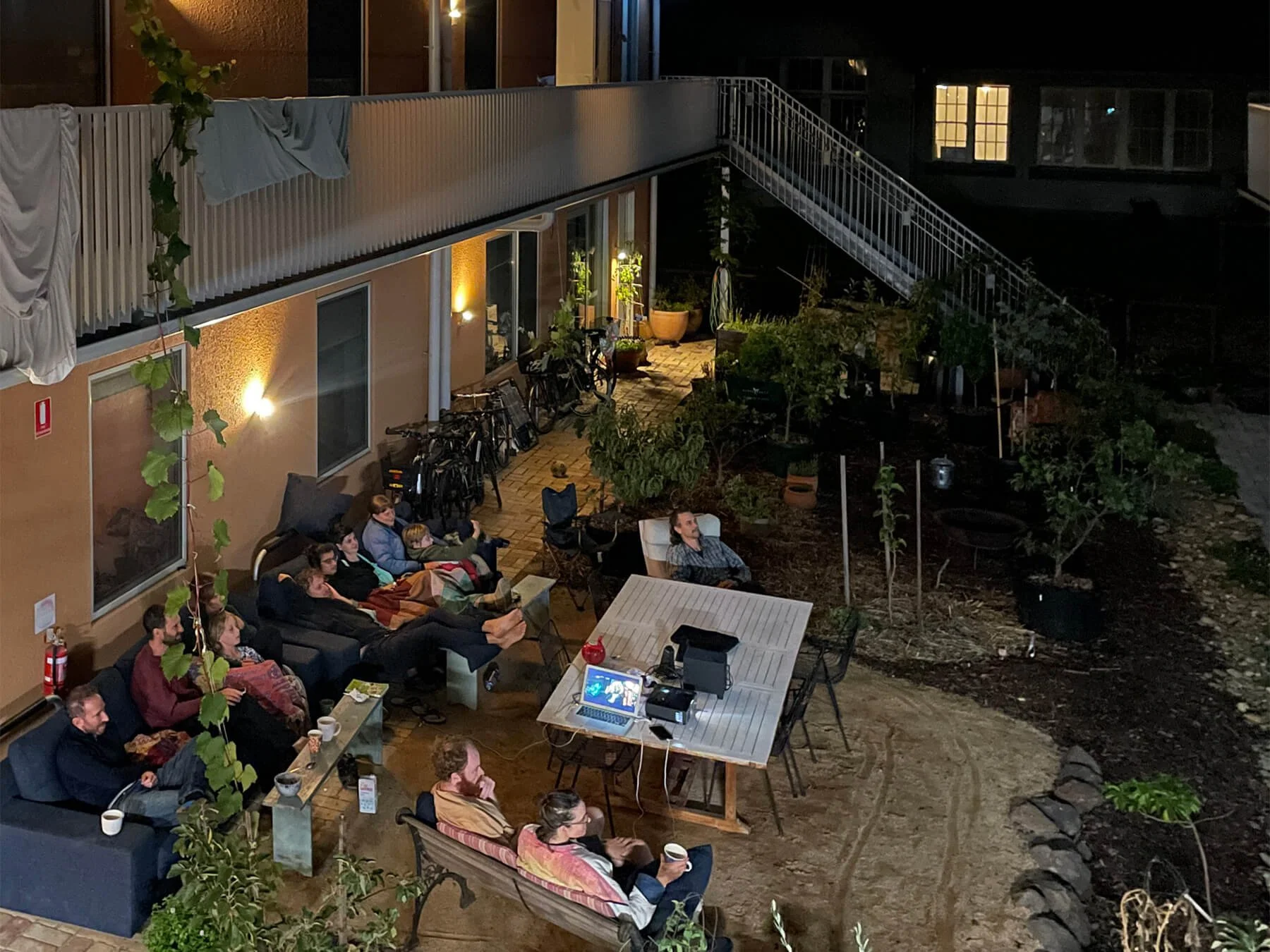
Film screening in the courtyard at Victoria Street Collective. Source: Ruth Giles
The project involved significant decisions. How did you approach decision making as a collective?
We broadly have a consensus-based approach to decision making, but we never had a very clear process. People approach decision making in different ways. Some people are quite decisive while others want more time. We were also dealing with the impacts of Covid-19. These factors meant all sorts of decisions and discussions kept being kicked down the road.
Six parties joined prior to Covid-19 and when the last four parties joined during the pandemic, they weren't brought in enough to the thinking that had happened so far and the decisions that had been made.
There was little appetite for online meetings and even after restrictions lifted there were challenges getting everyone together. For much of the project, we didn’t have regular in-person meetings. This meant some pretty big decisions were made online, including how we’d manage quotes from builders and trying to contain costs.
We also let some decisions slide, such as how we share the load on maintenance and administration, and how we manage car parking. Early on I found Loomio, a collaborative decision-making app, that I thought could assist us and record our decisions, but it wasn’t widely supported.
Fortunately, it's a group with loads of emotional intelligence so we fumbled our way through and stayed on good terms.
And collective decision making doesn't end with the completion of construction.
We have an asset that we need to manage, so there's ongoing work. We recently had two facilitated workshops and that was really useful for the group to get together. It allowed people to reflect on their experience of the development process and discuss our decision-making processes going forward.
How have you seen relationships within the collective evolve over time?
Many people already had existing friendships or experience living together which brought them into the project, whereas our family wasn’t part of that. By going through the process together and then living here over time, you continue to build relationships. People are also at different ages and stages of life. Our two children are a little older, so they have less interaction with the younger kids who are running around together.
“Having the support of close friends next door makes the everyday ups and downs of life a little easier to handle.”
It's a very friendly environment. You belong, which is really nice. If people are sitting down at the table in the communal garden, you can always join them. But you can't always expect equality of relationships. You need to be okay if some people are closer friends, or a smaller group of people within the collective do something together.
Looking back, what were some of the key lessons you'd pass on to anyone looking to do a similar project?
To begin with, Mum and I look back on it and go, “Phew, we're glad that worked out!”. Don't underestimate what you are getting involved with. You won't necessarily have the time or the skills to fully interrogate or monitor everything.
I would brief people more clearly. The briefing process is so important. That also comes back to how the group works together in discussing, agreeing and documenting priorities.
You also need to be flexible. What do you need, when do you push back, and what are you willing to let go of. There's a time imperative, so you have to make decisions and keep things moving. And that's an advantage of working with Property Collectives, who help drive the process along.
Different housing models have different levels of resident decision making and that's okay. Making decisions on a housing project is a big commitment. Some people want to be very involved while others don't always want to be. And the more people you have with their own specific requirements, the harder it can get to reach consensus.
It's also interesting to think about the role of investors and including rental properties as part of the mix. Having investors that are perhaps more focused on the product rather than all the decision making along the way could be useful.
Site selection is a major decision.
Yes, it's such a big component of the total project cost and critical to whether the development is somewhere people want to live. It can be challenging to find a site that everyone agrees on, especially if you're searching with a lot of people. We’ve known groups to spend years trying to settle on a site while land prices continue to rise.
I’d suggest progressing with any site that enough people can agree on to make the project viable, even if the group ends up splintering. Perhaps each splinter can form its own project, or a group can at least be proceeding with one project.
Another option with site selection that I’m curious about is retrofitting existing walk-up apartments, which do come up for sale from time to time. People then have somewhere to live from early on and can renovate the units when they have the money.
What are some broader changes that would better support alternative housing models?
It would be great to find ways of better connecting people who already live in different housing models, or are interested in those models, with developers and architects. We need to build networks for sharing information and knowledge about the benefits, challenges and risks, so that we make these projects easier in the future.
Changes to how bank valuations are undertaken would also be helpful. The assessment process is geared towards more traditional housing. We're counted as having zero car parking spaces as they are not on anyone's title, and that's the same for the communal open space. The bank valuations were relatively low because they have no way of valuing communal and shared facilities in a project this size, as well as the really high environmental performance of the homes we have built. This added to our financial pressures. I expect most of us will stay for many years, so it will be some time before we have actual sales data.
What benefits are you seeing through the design of the project and from living in an intentional community?
There's the environmental performance of the development including the communal photovoltaic array and the high level of comfort through the thermal performance of the building. There's also the sharing of tasks, resources and tools, for example with the communal garden.
If someone needs to pop out and wants someone to come and sit with their kids, or if you're making a meal and missing an ingredient, you can just ask. We also have a WhatsApp group which has an endless stream of messages such as ‘I’m going to have afternoon tea in the courtyard, does anyone want to join me’ or ‘Does anyone need anything from the shop’.
My mum’s friends are amazed that at 80, she moved into a vibrant, multigenerational community instead of aged care. She delights in conversations with the three-year-old next door. We drop-in multiple times a week, even just to pop in and say hello, which has greatly increased our connection.
-
PROJECT
Victoria Street CollectiveCLIENT
Resident ledARCHITECT
Zen ArchitectsLOCATION
Naarm / MelbourneCOUNTRY
Wurundjeri Woi WurrungPROJECT TYPE
ApartmentsCOMPLETED
2024—
Victoria Street is the ninth project by Property Collectives using their group build approach which empowers people to co-develop the homes and communities they want.
-
Building group as described by Property Collectives empowers people to co-develop the homes and communities they want at cost, giving people more control over the location, design and quality of their future homes.
Nationwide House Energy Rating Scheme (NatHERS) provides reliable energy ratings and information to improve the energy performance of Australian homes. NatHERS uses software tools to rate a home’s energy performance, considering its design, materials, major appliances, onsite energy production and storage, climate and location.
Take-out loan is the home loan that individuals obtain at the end of a construction project, once the subdivision is registered and titles are separated, to pay off (take-out) commercial construction finance.
-
-
Ruth Giles brings her professional experience in government and consulting together with her passion for building communities and addressing social isolation. She currently leads strategic projects for a homelessness and housing service organisation in Melbourne, Australia.
To a future city is licensed under a Creative Commons Attribution 4.0 International License.