Summerhill Village
Tim Hill, TANDEM Design Studio
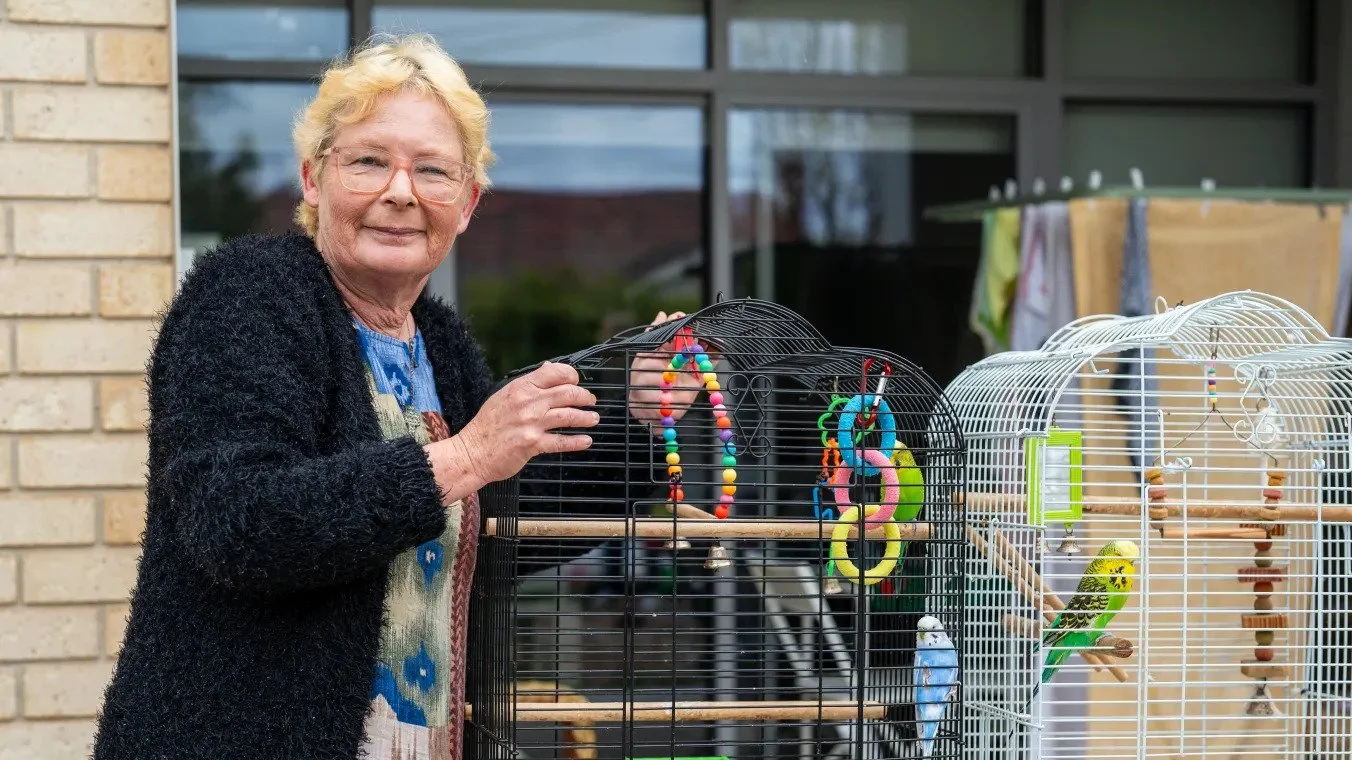
A Summerhill Village resident on her balcony. Source: Homes Victoria
Tim Hill from TANDEM Design Studio discusses Summerhill Village, a new social housing community in West Footscray. The result of a partnership between the Lions Club of Footscray and United Housing Co-operative, with funding support from Homes Victoria, the village provides 49 homes arranged around a shared central courtyard.
Tim describes the benefits of drawing on the lived experience of existing residents and project partners, and the approach to designing homes that meet the needs of UHC as long-term managers of the site. He also reflects on some of the challenges faced by community housing providers in delivering much-needed social housing, along with early feedback from residents living in the village.
Reading time: 11 minutes
It’s almost one year since Summerhill Village welcomed the returning and new residents. What feedback have you had?
It’s been really positive. We've had comments from residents which were just so heartening for us. One woman said she'd finally found a place where she feels safe with her daughter. Another woman said this is my forever home. To hear feedback that this is good quality, safe housing is fantastic.
How did Tandem first become involved with the project?
In 2018, I was introduced to Bert Jessup through a mutual friend. Bert was looking for an architect to design townhouses in Bright where he intended to retire. In getting to know Bert, he talked about being a member and past president of the Footscray Lions Club, and how for 18 years he had been responsible for maintenance at the Footscray Lions Senior Citizens Village (now Summerhill Village).
The village was built by club members in 1961 through fundraising, donations and volunteer labour. The retirement units were very humble, and they were deteriorating as the site was a former bluestone quarry so there was a lot of movement and cracking. Bert clearly felt great responsibility for the people he'd been looking after and was trying to find a way to renew the site. As we worked on the townhouses, we continued to talk about the village.
Who was living there at the time?
There were 21 elderly Filipino women and one man living there. The residents had formed a tight-knit community. They were primarily Catholics, so celebrations such as Christmas and Easter were very important with lots of cooking and singing. They were also keen gardeners and had established a beautiful garden in the central courtyard.
The Covid-19 pandemic unlocked opportunities for the project.
I visited the site in 2020 just before we went into the first Covid-19 lockdown. We were eligible for JobKeeper which allowed us to provide some concepts for what a renewal of the village might look like. Then the Andrews Government announced the Big Housing Build which meant there was a potential avenue to fund the project.
What options did the Lions Club explore before going ahead with the renewal of the site?
They explored a number of options through the initial feasibility process. Some options, such as subdivide and sell, were straight forward and would have made a lot more money. But this club has a very strong identity with providing housing for people in difficult circumstances. It’s been a part of their story for as long as many people have been members. They identify with the philanthropic cause and were excited by the concept designs.
“We were in a very fortunate position of being able to draw on everyone’s lived experience.”
How was the brief for the project developed?
There was no formal brief. We had a series of presentations and conversations around the question “what could we do?”. We were in a very fortunate position of being able to draw on everyone’s lived experience. There was the Lions Club as owners and operators of the site, there was a group representing the existing residents, and then United Housing Co-operative (UHC) who became the community housing provider for the project.
There was always the intention to increase the number of dwellings on the site. The Lions Club also needed to partner with a registered community housing provider to secure funding. That meant that the resident mix would evolve with UHC bringing in new residents who they wanted to house.
The Board of UHC also brought a particular focus on the social impact of the project to these conversations, including being able to age in place, and the potential for support networks to develop between single mothers and the older women who were already living there.
How did the design response evolve from this more informal briefing process?
There was a strong desire early on from the Lions Club and the residents to reinstate the courtyard. We were very supportive of this approach. We did test different building options, but they didn't work with the depth of the site which really suited a courtyard model.
We then looked at the design of the units alongside a strategy of coiling them around the site to reinstate the central courtyard. There were discussions about the unit mix which resulted in a total of 49 dwellings with different types of one and two-bedroom apartments. We obviously needed to comply with relevant standards including the Better Apartment Design Standards and the Livable Housing Design Standards (Silver). We were also very mindful of meeting the planning requirements, so we had a strict envelope for the building with a maximum height of three storeys.
The village is located on a larger site in an area of mainly one and two-storey detached dwellings. We wanted the project to sit comfortably in this context. To break up the bulk of the building, we introduced laneways along the street frontage resulting in four distinct building elements that are much closer to the scale of the neighbours. This also means that many of the apartments have three aspects with outlook to the street, laneway and courtyard, which is really awesome for daylight and natural ventilation.
So the design evolved through our conversations with the Lions Club, the residents and UHC, alongside our testing of the courtyard typology, planning envelope, unit mix and resulting yield.
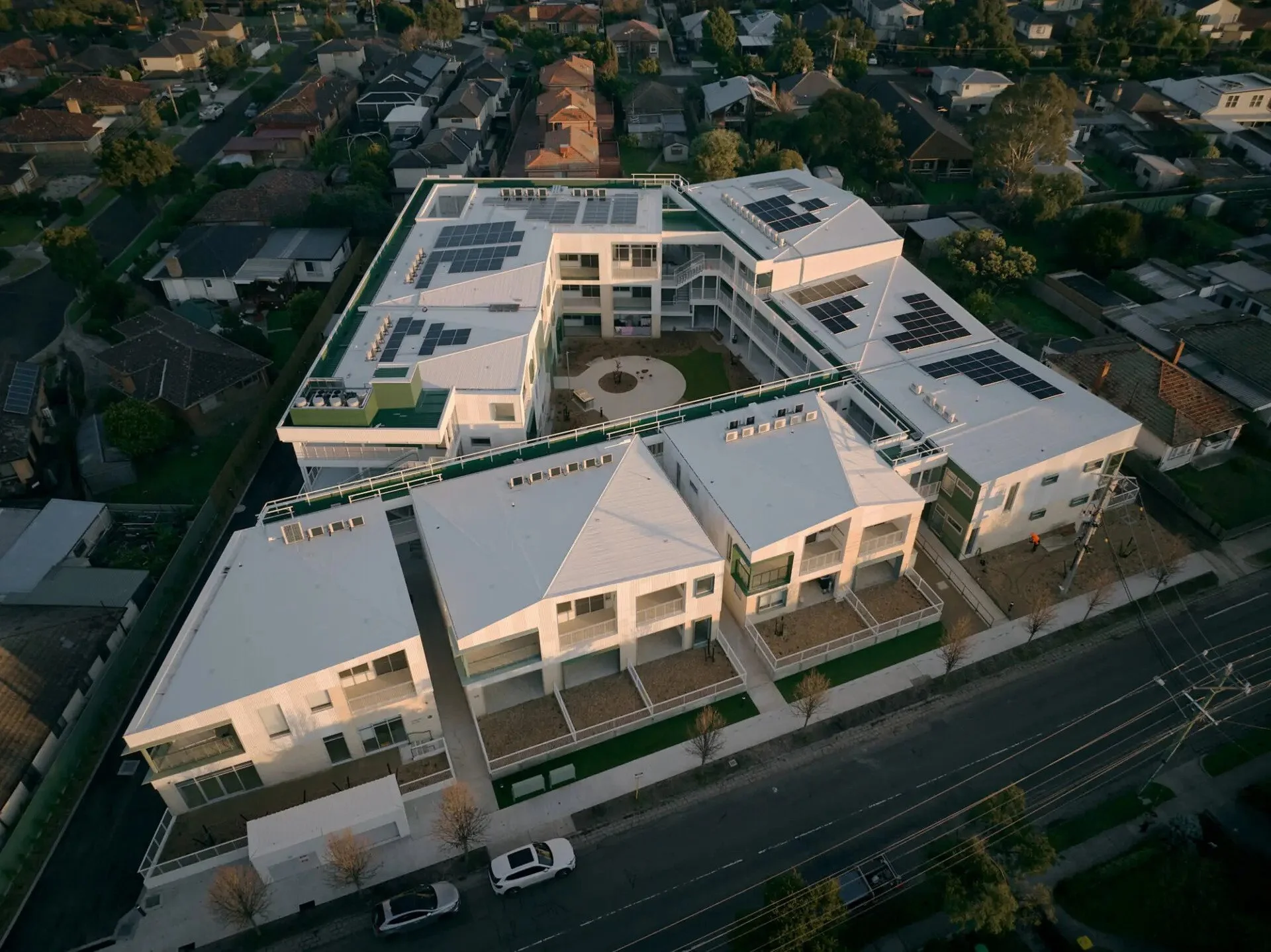
Aerial view of Summerhill Village. Source: Tom Ross
Providing for both independent and communal living was there from the beginning?
The ability for residents to live independently and choose to come together was there right from the start. That's a legacy from the earlier village where they had the courtyard as well as a commercial kitchen. The Lions Club met at the village every month and for festivities such as Christmas or Easter, the members and residents would come together to celebrate so they knew each other really well. We were invited to some of these events, and it was so welcoming with lots of cooking and singing. Providing opportunities for resident interaction was also important for UHC, who are a true housing co-operative. They have principles that tenant members are required to meet including contributing to the Summerhill Village community and its well-being.
“For the first time in my life, my daughter and I feel safe.”
Were there any specific requests from the existing residents that stood out?
For the Filipino women, it was all about cooking and gardening! They talked about how they love to cook fish, but fish stinks – that’s their words, not mine. They wanted to cook outside, but not in the central courtyard because then everybody else has to put up with it. The women were really delighted when we were able to provide an outdoor barbeque area that is oriented away from the courtyard with views across the neighbourhood.
As well as the courtyard, there are other shared garden spaces that resulted from the shape of the site and planning setbacks. The women wanted to reserve spaces along the rear of the site for growing vegetables. We were also able to provide private gardens to nearly all of the ground floor apartments.
How did the partnership between Lions Club and United Housing Co-operative come about?
The Lions Club needed to partner with a community housing provider in order to apply for funding. Bert also had previous experience working with a more commercial provider and didn't think that was the right type of partnership for this project. There were discussions with several providers, both nationally and in Victoria, and in the end the Lions Club went with UHC.
When was the partnership formalised?
After the initial design work but before applying for the funding grant and preparing the town planning application. This is where social housing projects can become tenuous, because UHC had to spend a lot of money on consultants to prepare information for the funding grant and the town planning application.
How were project costs split between the Lions Club, United Housing Co-operative and the Victorian Government?
The Lions Club provided the land as their contribution. Homes Victoria invested more than $17 million with UHC providing the remaining funds. Escalating construction costs put a lot of pressure on UHC to meet the funding gap. I’ve heard different figures for the total cost, with Homes Victoria stating $32.3 million.
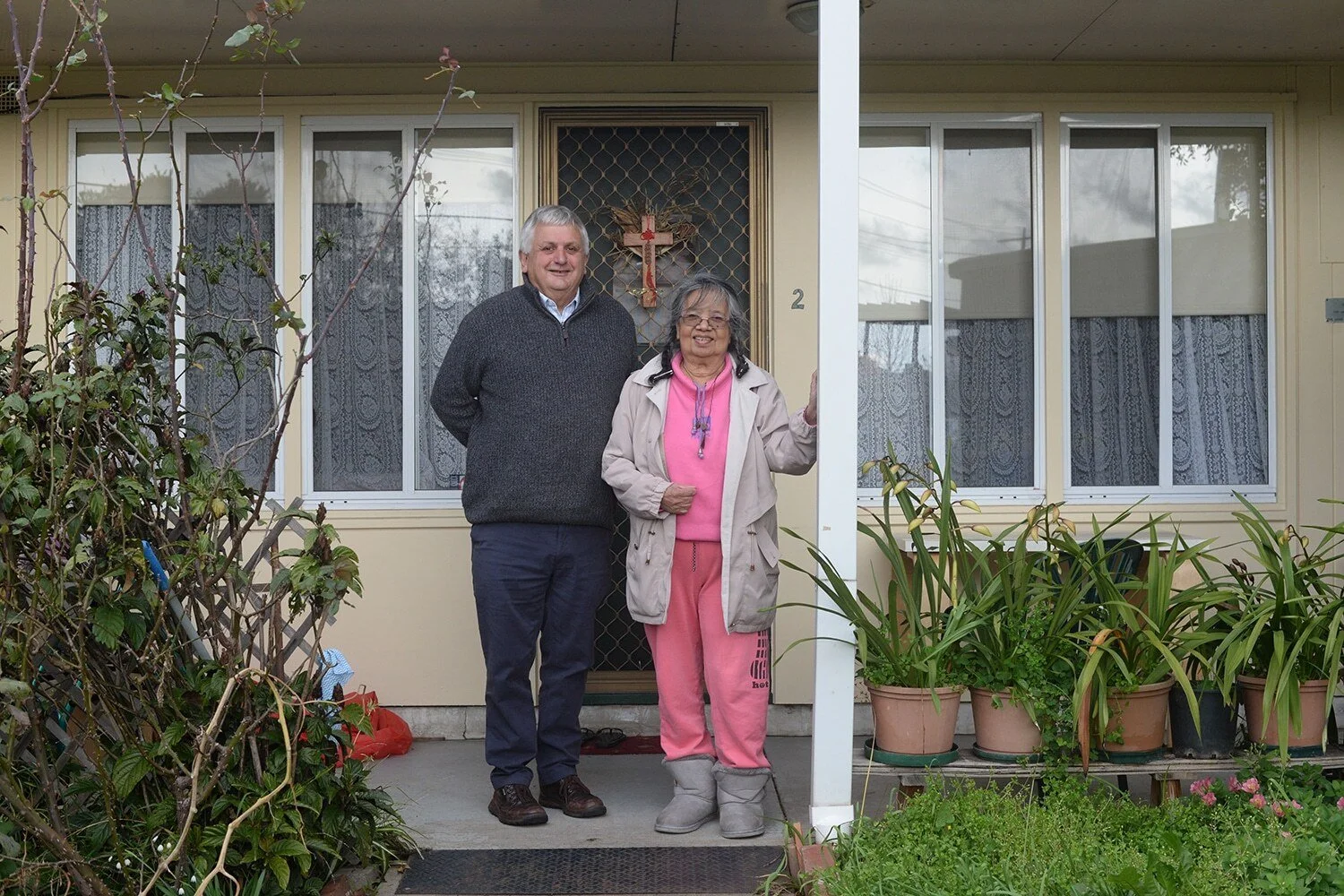
Bert Jessup with a resident at the previous Footscray Lions Senior Citizens Village. Source: Maysie Lecciones
What was the process for securing government funding?
It was a lot of work, but the application process itself was straightforward, and we were in a good position to meet the funding criteria. The partnership between the Lions Club and UHC was already in place. We had the design and knew the yield. We'd done preliminary site investigations, structural and services engineers were involved, and a quantity surveyor had prepared a cost plan. All of this strengthened our application as the government was looking for confidence that we had an understaning of the likely cost.
When did you receive the funding?
We heard the funding application was successful over the Christmas and New Year period of 2020–2021. It was one of the first successful applications and there was a lot of excitement.
You then went through the planning application process.
As part of the Big Housing Build, the Victorian Government had established a streamlined planning pathway to support the delivery of social and affordable housing. Our design complied with the planning envelope and social housing was an existing use on the site. We presented the proposal online to around 120 community members and ended up receiving letters of support. Maribyrnong City Council were also very supportive of the project. All of this made the planning application very straightforward.
You focused on standard construction methods and materials. There was more to this approach than just managing escalating construction costs?
We did look at more innovative construction methods early on. Could it be prefabricated? Could we use cross-laminated timber? But projects like Summerhill Village have a long timescale for return on investment. Longer than product warranties.
So we had to think very carefully about the way things were put together and the maintenance of the building, while also managing escalating construction costs post-Covid-19. We went for straightforward, reliable methods of construction that we knew would last a long time. We used readily available materials that people know how to work with, maintain and repair, such as brick, colorbond steel and painted fibre cement sheet.
Site conditions also resulted in cost escalations during construction.
The site turned out to be heavily contaminated. It was a former bluestone quarry and there was a lot of degraded fill. We had to drill wells and check for off-gassing. That was a cost that the client negotiated to share with the builder. And then about half the site needed piling. These were huge costs.
You were the Principal Design Consultant (PDC). What did that mean for your role on the project?
We were required to do full design, coordinate sub-consultants, and provide design advice and oversight throughout the project. This means the architect has more influence, but also a lot more responsibility, on key decisions during the design and construction process. We shouldn’t look to escape that responsibility, but at the same time there are a lot of decisions that need to be made on site where the builders have plenty of expertise. This type of arrangement can put the architect and builder into isolated camps where you can end up with lots of problems.
We were just really lucky to have a great builder with Devco. It felt like a good partnership and by cooperating and sharing our problems we found the best way through. While we were appointed as the PDC, you can’t always behave like that because you don’t know everything. You need to work with the people on site that actually put things together and listen when they have good ideas.
“Everybody who got involved in this project kind of got lit up by the idea of what it could be and the potential for positive social impact.”
What was the offer to existing residents during construction and what was the approach for moving residents into the new development?
The Lions Club found accommodation for all existing residents during construction, and I know residents were relocated nearby as they would visit the site to see how things were going. All existing residents were able to return if they wanted to. In the end about half of the residents came back. There were various reasons for this. Some of the residents were happy to stay where they were relocated. Other residents may have needed a higher level of care or had passed away.
When construction was completed, the Lions Club residents moved in first to give them some time to resettle. They were really delighted to be living there again. The UHC residents, who are primarily women over the age of 55 or single parents, then moved in a short time later.
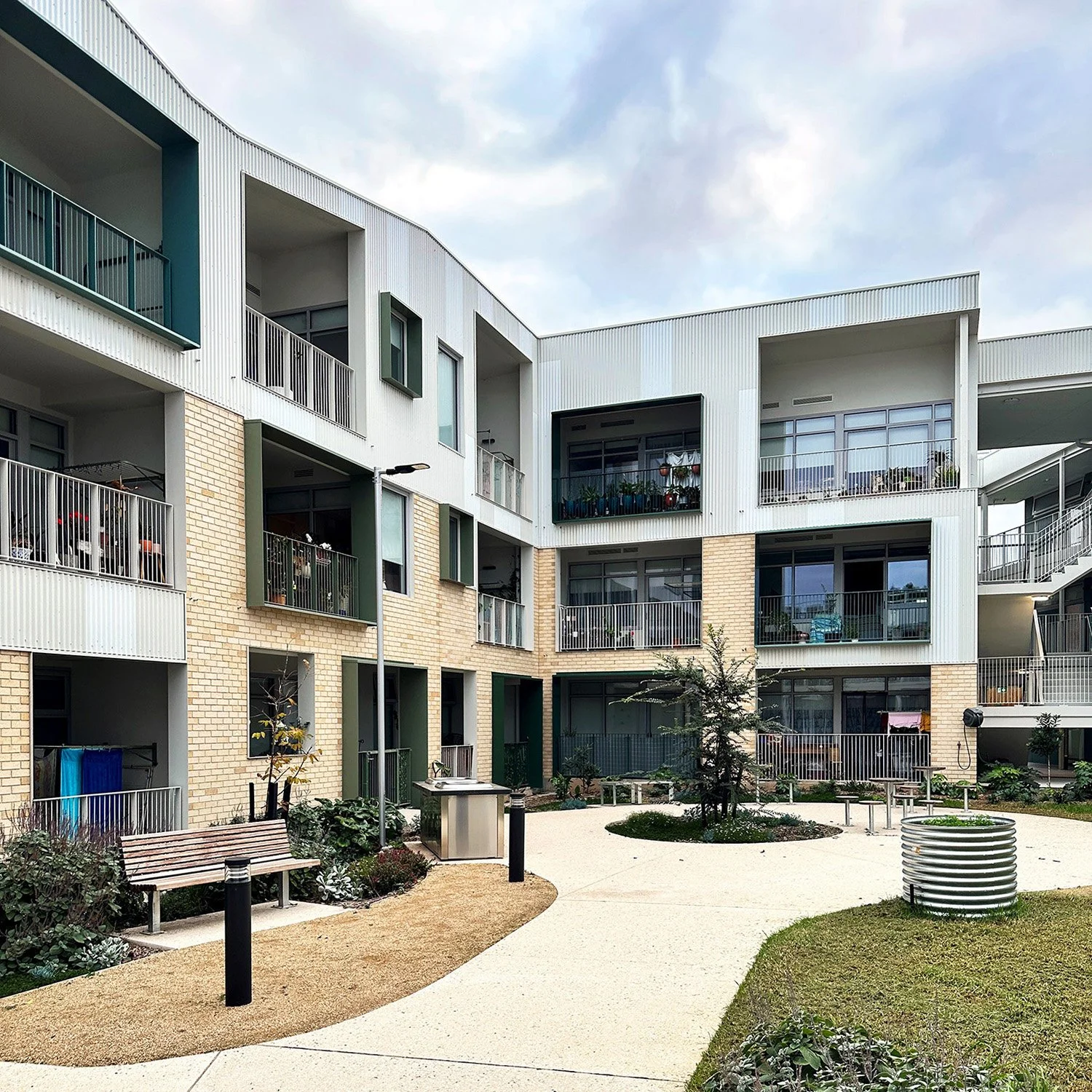
View of the central courtyard at Summerhill Village. Source: To a future city
How is the ownership and management of the village now structured between the Lions Club and UHC?
The level of apartment ownership reflects the joint venture contribution split between the Lions Club and UHC, with UHC owning most of the apartments. The Lions Club will continue to draw rent from their apartments, with a transfer of ownership to UHC over an agreed timeframe so that all dwellings will eventually end up with UHC. As a community housing provider, UHC now manages Summerhill Village.
What solutions were employed to improve the long-term efficiency, comfort and sustainability of the project?
The project utilises passive solar design and passive ventilation. It's 100% electric and there's a substantial rooftop solar array. Rainwater tanks provide water for the gardens. All this materially reduces running costs for the residents and UHC, and improves the environment that people are living in.
What are some of the key lessons from the project?
We need more investment in social and affordable housing, but I think just adding money to a sector has risks. Just because you have money doesn't mean you automatically have expertise. I've spoken to many small and medium-sized community housing providers who said they'll never go for this type of funding because it's so risky. There are so many unknowns within the construction process that the providers can't control. The government is very cautious about overruns when they're spending public money, so a provider can end up being caught with an obligation to meet the requirements of the deed without enough money to get there. And that’s a terrifying prospect for a small to medium sized community housing provider. I know that UHC had a tough time managing the cost escalations on this project.
There's also a missed opportunity around the expertise you develop delivering a project like this. The Victorian School Building Authority has a supplier panel. If you're on the panel and you do a good school, you'll probably get another one. You build expertise in schools. We'd love to do another project like Summerhill Village, but it's not really clear how we use our expertise to get another one.
Finding sites for social and affordable housing in the right locations that are viable and stack up is really difficult if you're competing with private developers. Then if you look at the process we went through, there's a much lower risk for community housing providers to use funding programs that allow them to buy off the plan from a developer.
We started with feedback from the residents. What have you heard from United Housing Co-operative as operators?
They’re delighted with the quality of the project which means they have a much better facility to run and manage.
You’ve spoken about the importance of the team. There was clearly a real commitment from everyone involved to the social impact of the project.
We were so fortunate to have such a great team. And I really want to put a plug in for Mirjana Knezevic and Nunzio Loria from Devco, and Alex Strickland and Andrew Scrinis from Lagada. The project wouldn't have happened without people like that.
Everybody who got involved in this project kind of got lit up by the idea of what it could be and the potential for positive social impact by providing secure housing in a setting that supports community. In the end, I think we did the little things really well, and it turned into a good thing.
Editors’ postscript
We recently returned to Summerhill Village and met a resident on the street. Along with generously inviting us to look at the courtyard, she spoke about how much she liked her new home, the friendly and welcoming community, and how people enjoyed using the communal facilities, especially the shared gardens. It was wonderful to have heard these reflections from a resident ahead of publishing this interview.
-
PROJECT
Summerhill VillageCLIENT
Footscray Lions Club, United Housing Co-operative and Homes VictoriaARCHITECT
TANDEM Design StudioLOCATION
Naarm / MelbourneCOUNTRY
Wurundjeri Woi Wurrung and Bunurong peoples of the Kulin nation.PROJECT TYPE
Social housing apartmentsCOMPLETED
2025 -
Better Apartment Design Standards set out how apartments can be designed to provide good functional places to live.
Community Housing Provider (CHP) is a registered not-for-profit organisation that develops, owns or manages secure, affordable rental housing for people on low incomes or with special needs.
JobKeeper was an Australian Government wage subsidy program to support employees and businesses impacted by Covid-19 to cover the costs of their employees’ wages. The program ran from 30 March 2020 to 28 March 2021.
Livable Housing Design Standards is a set of technical provisions prepared by the Australian Building Codes Board (ABCB) that if complied with enable dwellings to better meet the needs of the community, including older people and people with mobility limitations. This ABCB Standard has been adapted from the ‘Silver’ level requirements of the Livable Housing Design Guidelines which were first published by Livable Housing Australia.
Principle Design Consultant (PDC) is a procurement and contractual term commonly used in construction and design projects, particularly in the public sector, to describe the lead design firm appointed directly by the client.
-
-
With his long-time business partner and friend James Murray, Tim Hill is a founding director of TANDEM.
TANDEM commenced in 2005 as an idea about working together, co-operating and understanding each other’s perspectives.
TANDEM designs buildings. Our effort to improve the processes and outcomes in the built environment are summed up by ‘making things better’ by ‘making better things’.
TANDEM has a deep and abiding interest in construction. We believe that by understanding the processes of building, we can elevate our buildings to architecture.
TANDEM’s broad portfolio of work covers many traditionally isolated specialties in the design industry and includes museums, multi-residential, private homes, public markets, industrial buildings, medical centres, community centres, schools, theatres, libraries, hotels and social housing.
This broad experience in building design reflects an ongoing curiosity about the possibility of good design, alongside a flexibility to add value to many different building types.
To a future city is licensed under a Creative Commons Attribution 4.0 International License.